Call : +91-9840519139

Skin Care for Kids
Dr. Annie Flora. G (Dermatologist)
5/29/2026
Little Skin, Big Protection.
The Complete Parent's Guide to Moisturisers and Sunscreen for Children — What to Use, What to Avoid, and How to Keep Your Child's Skin Safe
Ray & Rio Skin & Hair Clinic | Paediatric Dermatology, Chennai, Tamil Nadu
Your Child Just Ran in From Play. Sweaty, Happy, and Thoroughly Sun-Kissed.
There are few things more joyful than watching a child play — the cricket matches on the road, the evening park runs, the cycle rides in the Chennai heat, the beach trips, the school sports day under an unforgiving April sky. Children are built for movement, for outdoor adventure, for all of it.
But here is what most parents do not realise: a child's skin is fundamentally different from an adult's. It is thinner, more permeable, less equipped with fully matured barrier defences, and far more vulnerable to both UV radiation and the chemicals we apply to protect it. A child's skin absorbs ingredients at a higher rate than an adult's — which means that what goes onto their skin matters enormously.
And in Chennai, where UV index values regularly touch extreme levels from March through June, where humidity and sweat are year-round companions, and where outdoor play is not optional — it matters more than ever.
This blog is a companion to our recent reel on moisturisers and sunscreen for children. Consider this the deeper conversation — the science behind the choices, the ingredient labels decoded, and the guidance you need to make confident, safe decisions for your child's skin every single day.
Children are not small adults. Their skin is a work in progress — beautiful, sensitive, and deserving of products and care designed specifically with their biology in mind.
Why Children’s Skin Needs Different Care
Understanding why children's skin behaves differently helps explain why you cannot simply use adult products on your child — even if they seem mild or are marketed as 'natural'.
Thinner skin barrier: A child's stratum corneum (the outer protective layer of the skin) is thinner and less mature than an adult's, meaning it is more easily disrupted by external irritants, allergens, and harsh ingredients.
Higher surface-area-to-body-weight ratio: Children absorb a proportionally larger amount of any applied product relative to their body weight. An ingredient that causes negligible systemic absorption in an adult can have a more significant effect in a child.
Less effective thermoregulation: Children overheat faster, sweat differently, and are more susceptible to heat-related skin flares — prickly heat, miliaria, and sweat-induced eczema — all common in Chennai's climate.
Immune system still developing: The skin's immune defences are not fully mature in childhood, making children more susceptible to allergic contact dermatitis, fungal infections, and reactive skin conditions.
More UV-sensitive: The melanocyte-keratinocyte relationship in children's skin is still maturing. Sun damage accumulated in childhood is a significant risk factor for skin cancer in adulthood — making early sun protection habits truly life-altering.
Before They Step Out: The Pre-Play Skin Prep
Moisturising Before Sun Exposure
Yes — moisturising before going out is important, even in humid Chennai. Well-hydrated skin maintains its barrier function better, is less prone to sun-related irritation, and recovers faster from heat exposure. The key is choosing the right moisturiser for your child's skin type — more on that shortly.
Apply moisturiser at least 10 to 15 minutes before sunscreen. This allows the moisturiser to absorb and the skin barrier to be optimised before the sunscreen layer goes on top.
The Sunscreen Rule — Non-Negotiable in Chennai
If there is one habit worth instilling in every child in this city, it is daily sunscreen. Not just at the beach. Not just on holidays. Every. Single. Day. - based on theirt activities.
Here is what you need to know about sunscreen for children:
SPF 50 or higher: In Chennai's UV conditions, anything below SPF 50 provides insufficient protection for children's skin. Look for SPF 50 or SPF 50+.
Broad spectrum: The label must say 'broad spectrum' — meaning it protects against both UVA (which causes ageing and pigmentation) and UVB (which causes burns). Also look for PA+++ or PA++++ ratings, which indicate UVA protection.
Mineral sunscreen is the gold standard for children: Zinc oxide and titanium dioxide are physical UV blockers that sit on the skin's surface and reflect UV rays. They do not absorb into the skin, making them far safer for children than chemical UV filters. We strongly recommend mineral sunscreens for all children, especially under five years of age.
Apply generously and early: Apply sunscreen 20 minutes before going outside, giving it time to form its protective layer. Use about a teaspoon for the face and neck, and ensure all exposed areas are covered — don't forget the ears, back of the neck, and tops of feet.
Reapply every 2 hours: Sunscreen wears off with sweat and activity. If your child is playing outdoors for an extended period, reapplication is essential. Keep a small sunscreen with you at the park.
Dermatologist Tip: For children under 6 months of age, avoid sunscreen entirely — use physical shade and protective clothing instead. For children aged 6 months to 2 years, use only mineral sunscreens with zinc oxide, preferably fragrance-free and formulated specifically for infants.
When They Come Back Home: The After-Play Recovery Routine
The skin your child comes home with after two hours of outdoor play in Chennai's heat is not the same as the skin they went out with. It has been battling UV radiation, sweat, dust, heat, and possibly minor irritants from grass and surfaces. The after-play routine is about recovery — gently cleaning, rehydrating, and soothing the skin barrier.
Step 1 — Gentle cleansing: Use a mild, soap-free, pH-balanced cleanser to remove sunscreen, sweat, and surface irritants. Avoid scrubbing. Lukewarm water, not hot — hot water strips the skin's natural oils and worsens dryness.
Step 2 — Pat dry, don't rub: Use a soft cotton towel and pat the skin dry gently. Rubbing damages the skin barrier and can trigger flares in children with sensitive or eczema-prone skin.
Step 3 — Apply moisturiser while skin is still slightly damp: This is the most effective time — the moisturiser seals in residual moisture. Use the right formulation for your child's skin type (see the guide below).
Step 4 — Check for any redness, rashes, or irritation: After outdoor play, do a quick visual check of your child's skin — particularly the neck, face, and any areas that were exposed to sun or grass. Redness that does not settle within 30 minutes, new rashes, or any blistering should be assessed by a dermatologist.
Step 5 — Hydration from inside: Make sure your child drinks adequate water after outdoor activity. Skin hydration is partly systemic — a well-hydrated child has better skin barrier function.
Choosing the Right Products: A Skin-Type Guide for Parents
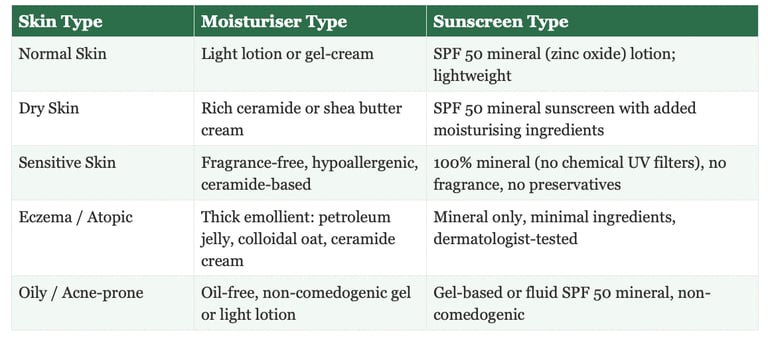
Not all children's skin is the same. Here is a practical guide to help you choose the right moisturiser and sunscreen based on your child's skin type and any existing conditions:
A Closer Look at Each Skin Type
Regular / Normal Skin
Lucky parents! A light, non-greasy lotion or gel-cream moisturiser works well. Look for ingredients like glycerin, aloe vera, and ceramides. For sunscreen, a lightweight mineral SPF 50 lotion is ideal — easy to apply and leaves minimal white cast when formulated specifically for children.
Dry Skin
Dry skin in children — especially during Chennai's cooler months or in air-conditioned environments — benefits from richer, creamier moisturisers. Look for ceramide-containing creams, shea butter formulations, or petroleum jelly-based products. Apply within 3 minutes of bathing for maximum effect. Sunscreens with added emollient ingredients (zinc oxide with glycerin or ceramides) provide both protection and hydration.
Sensitive Skin
For children with sensitive skin, the rule is: fewer ingredients, better. Choose fragrance-free, dye-free, preservative-minimal formulations. Ceramide-based creams and colloidal oat-based moisturisers are excellent choices. For sunscreen, 100% mineral formulations with only zinc oxide (or zinc oxide and titanium dioxide) and minimal other ingredients are the safest option. Avoid anything labelled 'with a pleasant scent' — synthetic fragrance is one of the most common allergens in paediatric skin reactions.
Eczema / Atopic Dermatitis
Children with eczema need consistent, generous moisturising — twice daily minimum, even when the skin looks clear. Thick emollients (not light lotions) are essential: petroleum jelly, ceramide-rich creams, and colloidal oatmeal formulations. Sunscreen selection is critical — only dermatologist-tested, minimal-ingredient mineral products. Important: eczema management in children requires medical supervision. Please do not manage eczema with home remedies or over-the-counter hydrocortisone without a dermatologist's guidance.
Oily or Acne-Prone Skin (Older Children / Tweens)
Pre-teen skin brings its own challenges. Lightweight, oil-free, non-comedogenic gel moisturisers work well. For sunscreen, fluid or gel-based mineral SPF 50 products that are non-comedogenic are available and work very well on oilier skin. Avoid anything heavy or occlusive.
Ingredients to Look For in Children’s Skincare
When reading a label for your child's moisturiser or sunscreen, these are the ingredients that earn a green light:
For Moisturisers
Ceramides (1, 3, NP, AP, EOP): Replenish the skin's natural barrier lipids. Excellent for all skin types, essential for eczema-prone skin.
Glycerin: A humectant that draws moisture into the skin. Safe, gentle, and effective.
Colloidal Oatmeal: Anti-inflammatory, soothing, barrier-supportive. Ideal for sensitive and eczema-prone skin.
Hyaluronic Acid (low molecular weight): Excellent hydration for older children's skin. Gentle and non-irritating.
Shea Butter: Rich emollient for dry skin. Safe when used in unrefined or naturally-sourced form.
Niacinamide (low concentration, 2–4%): Gentle, barrier-supporting, anti-inflammatory. Suitable for sensitive and reactive skin.
Aloe Vera (pure, preservative-free): Soothing and hydrating for sun-exposed skin.
For Sunscreens
Zinc Oxide: The safest UV filter for children. Broad-spectrum, non-absorbed, photostable.
Titanium Dioxide: Safe mineral UV filter, particularly effective for UVB. Often combined with zinc oxide for broader coverage.
Parent Tip: When choosing a mineral sunscreen for your child, look for 'non-nano' zinc oxide — this means the particles are large enough that they do not penetrate the skin, offering protection without systemic absorption. 'Non-nano' is increasingly listed on labels of quality children's sunscreens.
Ingredients to Avoid — Especially EDC-Containing Products
This section is perhaps the most important one in this blog for parents to read carefully. Endocrine Disrupting Chemicals (EDCs) are substances that interfere with the body's hormonal systems. Because children's endocrine systems are still developing, they are particularly vulnerable to the effects of EDCs — even at low exposure levels. Several common ingredients in skincare and sunscreen products are classified as EDCs or suspected EDCs.
The following ingredients should be actively avoided in products used on children:
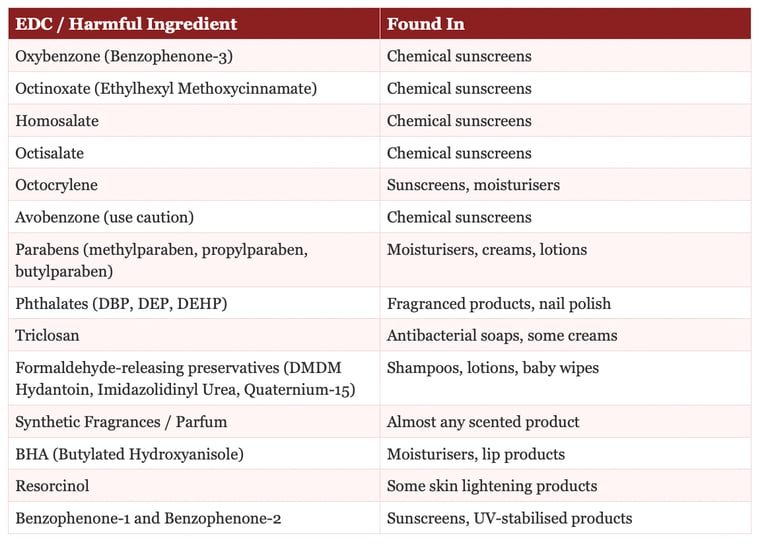
IMPORTANT: The presence of any of the above ingredients does not mean a product is illegal or that a single use is dangerous. The concern is cumulative, daily exposure over time — particularly through products applied to large body surface areas, like sunscreen and moisturiser. For children, whose skin absorbs more and whose developing hormone systems are more vulnerable, choosing products free from these chemicals is a sensible precaution supported by growing scientific evidence.
Additional Ingredients to Avoid in Children’s Skincare
Alcohol (denatured): Drying and irritating to children's skin. Found in many toners and 'lightweight' products.
Essential oils (tea tree, eucalyptus, peppermint, lavender): Despite being 'natural', essential oils are among the most common contact allergens in children. Avoid in young children and those with sensitive skin.
High concentrations of retinol or AHAs: Not appropriate for children's skin. These are adult active ingredients.
Artificial dyes and colourants: Added to make products visually appealing, they serve no skin benefit and are potential allergens.
Talc (in loose powders): Inhalation risk in infants; avoid talc-based powders for babies and young children.
When Your Child Has a Skin Issue — Please Do Not DIY
I want to speak directly to every parent reading this: the internet is full of advice about home remedies for children's skin. Coconut oil for everything. Turmeric pastes. Aloe vera from the garden. Breast milk for rashes. Sandalwood powder. Rice water.
Some of these are harmless. Some are actively problematic. And almost all of them delay the proper treatment of a condition that, in a child, can worsen rapidly without the right intervention.
Children's skin conditions that look mild can escalate quickly. Eczema that seems manageable can become infected. A rash that looks like heat rash can be a fungal infection requiring specific treatment. A patch of white skin is not always a fungal issue — it could be vitiligo or pityriasis alba, which need accurate diagnosis before treatment. A child who keeps scratching at night despite creams applied at home may have scabies that the whole family needs to be treated for.
When in doubt about your child's skin — please consult a dermatologist first. A ten-minute appointment can save weeks of misdiagnosis, unnecessary discomfort, and wasted expense on the wrong products.
Conditions that always warrant a dermatologist visit and should never be self-treated in children:
Any persistent rash that does not resolve in 48–72 hours
Redness, swelling, or warmth suggesting possible infection
White patches or unusual pigmentation changes
Scalp conditions: itching, scaling, hair loss, circular bald patches
Warts, molluscum (water warts), or unusual growths
Severe or weeping eczema
Any allergic reaction — hives, swelling, or difficulty breathing after applying a product (the latter is an emergency)
Sunburn that blisters or covers a significant body area
Nail changes, pitting, or separation
The Simple Daily Routine — Morning and Evening
Morning (School Day / Before Going Out)
Gentle cleanse (face): Mild, soap-free cleanser or plain water for young children.
Moisturise: Apply appropriate moisturiser for skin type while skin is slightly damp.
Wait 10–15 minutes, then apply sunscreen: SPF 50+ mineral sunscreen to all sun-exposed areas.
Dress for sun protection: Lightweight, full-sleeved cotton clothing, a hat, and UV-protective sunglasses where appropriate.
Evening (After Play / After School)
Gentle bath or wash: Remove sweat, sunscreen, and surface irritants with a mild cleanser.
Pat dry: Soft towel, gentle patting.
Moisturise immediately: While skin is still slightly damp. Generous application for dry or eczema-prone skin.
Check the skin: Quick visual check for any new rashes, redness, or changes.
Hydrate: Ensure your child drinks enough water through the day.
Frequently Asked Questions — Children’s Skin Care in Chennai
1. At what age can I start using sunscreen on my child?
From 6 months of age onwards, you can use a mineral (zinc oxide) sunscreen specifically formulated for infants. For babies under 6 months, rely on shade and protective clothing rather than sunscreen. From 2 years onwards, a broader range of mineral children's sunscreens is available and appropriate.
2. My child hates sunscreen because it leaves a white cast. What do I do?
This is the most common complaint with mineral sunscreens! Several brands now offer tinted mineral sunscreens for children, or formulations with micronised zinc oxide that reduces the white cast significantly while remaining safe. Finding a texture and formulation your child tolerates is worth the effort — try a few options rather than giving up on mineral sunscreen altogether.
3. Is coconut oil a good moisturiser for children?
Coconut oil is widely used in India and has genuine emollient properties. However, it is high in oleic acid, which can disrupt the skin barrier in children with eczema or sensitive skin. It is also comedogenic (can clog pores). For children with normal skin, occasional use is unlikely to cause harm. For children with sensitive, eczema-prone, or acne-prone skin, we recommend ceramide-based moisturisers over coconut oil. Always do a patch test before applying anything new to the full face or body.
4. My child got sunburnt. What should I do immediately?
First, move your child out of the sun immediately. Cool (not cold) water compresses or a cool bath can help soothe the burn. Apply a gentle, fragrance-free aloe vera gel or a mild moisturiser. Ensure good fluid intake. Do not apply ice, butter, or toothpaste (common home remedies that can worsen the burn). If the burn covers a large area, blisters, or your child has fever or severe pain, see a doctor promptly.
5. Are baby products the same as children's products?
Not always. 'Baby' products are typically formulated for newborn to 12-month-old skin — they are very gentle and often more dilute. Children's products (toddler to tween) may contain a broader range of ingredients. Always check the age recommendation on the label, and when in doubt for a child with sensitive skin, a dermatologist's recommendation for a specific product is far more reliable than marketing claims.
6. My child has eczema. Can I use any over-the-counter steroid cream?
Please do not use any steroid cream on your child without a prescription from a dermatologist. The strength of the steroid, the area of application, the duration of use, and the age of the child all matter enormously in eczema management. Incorrect use of topical steroids on a child's skin can cause skin thinning, growth suppression in severe cases, and worsening of the condition if the diagnosis was incorrect. Eczema in children is very treatable — with the right medical guidance.
7. How do I know if a sunscreen product contains EDCs?
Read the ingredient label. Look for oxybenzone, octinoxate, homosalate, octisalate, octocrylene, and parabens. If any of these appear, choose an alternative. Reliable mineral sunscreens for children will list only zinc oxide and/or titanium dioxide as their active UV-filtering ingredients. Apps like INCI Beauty or Think Dirty can help parents quickly scan product labels for potentially harmful ingredients.
Start Early. Protect Well. Build Habits That Last a Lifetime.
Children who grow up with healthy skincare habits carry those habits into adulthood. A child who learns to apply sunscreen before going out, who understands why their skin needs protection in Chennai's climate, who has a simple and consistent moisturising routine — that child becomes an adult with far lower risk of sun damage, pigmentation, and skin cancer.
It does not need to be complicated. Two products, applied consistently, with the right ingredients — that is all it takes to make a meaningful difference to your child's skin health over a lifetime.
And when your child's skin does need a little extra help — whether it is eczema that flares every summer, a persistent rash, a patch of unusual texture, or any change that concerns you — please come to us early. In paediatric dermatology, as in most medicine, earlier is almost always better.
Your child's skin is not something to experiment on. It is something to protect, with knowledge, with the right products, and with professional support when you need it.
You don’t have to have all the answers. You just have to ask the right people. And we’re right here.
Need Help with Your Child’s Skin? You Know Where to Find Us.
At Ray & Rio Skin & Hair Clinic, we see children of all ages for a wide range of skin and hair concerns — from newborn skin conditions to teenage acne, from eczema and vitiligo to sunburn care and scalp conditions. Our approach is always gentle, evidence-based, and designed around your child's individual skin needs.
If you have a concern — no matter how small it seems — please do not wait. Book a paediatric dermatology consultation with us and let us take a proper look.
📌 Book Your Child’s Skin Consultation: Click here
Because your child’s skin deserves the very best care — and so do you.
DISCLAIMER: This blog is intended for general educational purposes only. It does not constitute medical advice and is not a substitute for a professional consultation with a qualified dermatologist. Every child's skin is unique, and what works for one child may not be appropriate for another. If your child has a skin condition, allergy, or any concern about their skin or hair, please consult a paediatric dermatologist before introducing any new product or treatment. Do not attempt to self-treat skin conditions in children with home remedies or over-the-counter products without professional guidance.
Paediatric dermatologist Chennai | Sunscreen for kids India | Children skin care Chennai | EDC free sunscreen baby | Moisturiser kids dry skin | Baby sunscreen zinc oxide India | Eczema children Chennai | Kids skin rash treatment Chennai | Best children sunscreen Tamil Nadu | Ray Rio skin clinic Chennai / sunscreen for kids Chennai, moisturiser for children India, baby sunscreen safe ingredients, EDC free sunscreen kids, children skin care Chennai, paediatric dermatologist Chennai, best sunscreen for kids India, kids moisturiser dry skin, safe sunscreen baby India, children sunburn care Tamil Nadu, Ray Rio paediatric skin clinic
Contact
Block A, Plot B1, 12th Cross St, Ranga Reddy Gardens, Saraswathy Nagar North, Neelankarai, Chennai, Tamil Nadu
+91 98405 19139
We are here!!!
Neelankarai
Egmore
No. 14/31, First Street, Sait Colony, Egmore, Chennai - 600008, Tamil Nadu
© 2025 RAY & RIO SPECIALITY CLINIC