Call : +91-9840519139

Hair Loss in Women
HAIR TREATMENTS
5/19/202612 min read
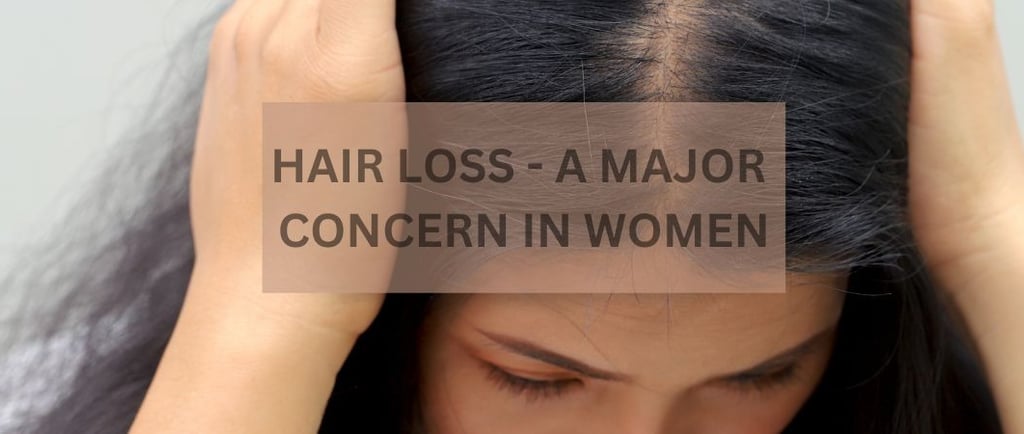
Your Hair Is Trying to Tell You Something.
Are You Ready to Listen?
A dermatologist's heartfelt conversation on women's hair loss — what causes it, what to do, and why you deserve to act now.
She Didn't Notice It Happening. And Then She Couldn't Ignore It.
It starts quietly. A few extra strands on the pillow. A little more hair on the bathroom floor than usual. You tell yourself it's seasonal, it's the water, it's nothing. You tie your hair up tighter and carry on — because there are deadlines to meet, children to feed, a household to run, exams to clear, parents to care for.
You are a woman who shows up for everyone. Every. Single. Day.
Maybe you're the working professional catching the 8am train in Chennai's relentless heat, juggling a career and a family with a grace that looks effortless from the outside. Maybe you're a new mother, three months postpartum, still in survival mode, quietly horrified by the handfuls of hair coming out every time you wash it. Maybe you're a student, burning both ends of the candle through exam season, running on coffee and anxiety and very little sleep. Or maybe you're the homemaker who keeps everything and everyone in order — and has quietly put herself last on every list for years.
Whoever you are — your hair has been trying to get your attention. And perhaps, until now, you've been too busy, too tired, or too dismissive of yourself to listen.
Hair loss in women is rarely just about hair. It is almost always the body's way of saying: something needs your attention. You need your attention.
I want to talk to you today — not at you, not through a clinical report, but to you. Woman to doctor, with honesty and warmth. Because what I see in my clinic every week in Chennai is not just hair loss. I see exhaustion. I see women who have been quietly struggling and finally arrived, often years later than they should have, hoping it's not too late.
It isn't. And we are going to talk about everything.
Let's Have an Honest Conversation — Starting with Your Life.
Before we talk treatments and procedures, I want to ask you some questions. Not as a checklist, but as a conversation — because hair loss in women is almost never caused by one single thing. It is almost always a combination of factors, layered over time, that finally tips the balance.
So sit with me for a moment. Let's look at your life together.
Your Diet and Nutrition — Are You Actually Nourishing Yourself?
I cannot tell you how many times I have seen a woman track her children's nutrition, her husband's protein intake, her parents' medications — and then tell me she 'eats fine,' only to discover she is significantly deficient in iron, ferritin, Vitamin D, Vitamin B12, or zinc.
Hair is one of the fastest-growing tissues in the body. It is also one of the first places the body cuts corners when nutrients are scarce. If you are not eating enough protein, if your iron stores are low (a common issue in Indian women with heavy periods or vegetarian diets), if you are low on biotin or folate — your follicles are the first to feel it.
Ask yourself honestly: are you eating three proper meals a day? Is there enough protein — eggs, lentils, legumes, paneer, fish, chicken — in your diet? Are you getting sunlight or taking Vitamin D? Have you had a blood test recently? If the answer to any of these is no, that is where we begin.
Your Sleep — The Rebuilding Hours You May Be Skipping
Hair growth happens at night. Cell regeneration, hormone regulation, tissue repair — all of it is largely nocturnal. And in a city like Chennai, where busy schedules, the heat, and screen time routinely push sleep past midnight, chronic sleep deprivation is one of the most underacknowledged contributors to hair loss.
If you are sleeping less than six hours regularly, if your sleep is fragmented and restless, if you wake up feeling more tired than when you went to bed — your body is in a constant state of mild stress. And stress, as we are about to discuss, is a very efficient hair thief.
Your Stress — The Invisible Load
There is a medical term — telogen effluvium — that describes the kind of hair loss triggered by physical or emotional stress. When the body is under pressure, it redirects resources away from non-essential functions (hair growth being one of them) and toward survival. The result is that a large number of hairs enter the resting phase simultaneously — and then fall out, usually two to four months after the stressful event.
This means the hair fall you are experiencing today may be the echo of a difficult period you went through months ago. A difficult pregnancy. A health scare. An exam season. A painful family situation. The loss of someone you loved. Grief shows up in hair, too.
Stress in Indian women is also often invisible — the emotional labour of managing homes and careers and families simultaneously, with very little space for rest or selfhood. This kind of low-grade, chronic stress is perhaps the most damaging of all, because it never quite peaks — it just persists
Your Hormones — The Chemical Conversation Happening Inside You
Hormones are among the biggest drivers of hair loss in women, and they are also the most commonly missed. Here is what I frequently see in my clinic in Chennai:
Postpartum hair loss: After delivery, oestrogen levels drop sharply. The hair that 'held on' beautifully during pregnancy now falls out in dramatic handfuls. This is temporary — but it can be frightening, and it can be prolonged if nutritional support and scalp care are not given.
PCOS (Polycystic Ovarian Syndrome): One of the most prevalent hormonal conditions in Indian women, and one of the leading causes of androgenetic alopecia in young women. If you have irregular periods, unexplained weight changes, acne, or facial hair alongside your hair loss — PCOS may be the thread connecting all of it.
Thyroid dysfunction: An underactive or overactive thyroid alters the hair growth cycle significantly. Many women in Tamil Nadu have undiagnosed or undertreated thyroid conditions — and wonder why their hair isn't recovering despite everything they try.
Perimenopause and menopause: Oestrogen protects hair follicles. As oestrogen declines with age, hair naturally thins — particularly at the crown and the parting. This is real, it is common, and it is treatable.
Your Unattended Health Issues — The Long Conversations You've Been Postponing
How many times have you told yourself you'll go to the doctor 'next month'? How many symptoms have you normalised — the fatigue, the irregular cycles, the bloating, the joint aches — because there is always something more urgent to attend to first?
Hair loss is frequently the body's loudest signal when quieter ones have been ignored. Anaemia, thyroid disease, autoimmune conditions, insulin resistance, nutritional deficiencies — all of these show up in the hair before they show up clearly anywhere else. Your hair falling is not vanity. It is a diagnostic signal, and it deserves to be investigated.
Your Insecurities — Let's Name Them, Because They Matter
I want to gently say something that doesn't get said enough in a medical context: hair loss is emotionally devastating for women, and that matters.
Our culture, our media, our identity — so much of a woman's sense of self is tied to her hair. When it thins, when the parting widens, when the ponytail feels half of what it once was — it changes how you see yourself. It changes how you move through the world. And for many women, there is a quiet shame attached to it, a sense that they should be able to fix this on their own, with better shampoo or a more disciplined lifestyle.
You are not failing. This is not your fault. And you do not have to carry it alone.
The Next Step: Come In. Let's Evaluate Everything.
Now that we have talked about the 'why,' let's talk about the 'what next.' Because the most important thing you can do — right now, today — is to stop waiting and seek a proper evaluation.
At our clinic in Chennai, we believe that the right treatment begins with the right diagnosis. And hair loss in women requires a thorough, multi-layered assessment — not a quick glance and a prescription.
Here is what a complete hair evaluation looks like with us:
Step 1 — A Detailed Consultation
We sit with you. We listen. We ask about your medical history, your menstrual cycle, your diet, your stress, your sleep, your family history of hair loss. We don't rush this conversation, because the most important information often comes from what you tell us — not from a test alone.
Step 2 — Hair and Scalp Analysis
Using trichoscopy (a specialised scalp imaging tool), we examine your scalp and follicles in detail. We assess the density of your hair, the health of the follicles, whether miniaturisation (thinning of the hair shaft) has begun, and the pattern of loss. This tells us what type of alopecia we are dealing with — and that changes everything about the treatment approach.
Step 3 — Targeted Blood Investigations
We guide you through the specific blood tests relevant to your history and presentation. This typically includes:
Complete Blood Count (CBC) — to check for anaemia
Serum Ferritin — iron stores, one of the most common deficiencies behind hair loss in Indian women
Thyroid Function Tests (TSH, T3, T4) — to rule out thyroid-related loss
Vitamin D3 and B12 — frequently deficient in urban Indian diets
Hormonal profile — testosterone, DHEAS, prolactin, and others where PCOS or hormonal alopecia is suspected
Blood sugar and insulin resistance markers — especially relevant in Tamil Nadu's demographic profile
We do not run blanket tests. We run the ones that matter for you.
Your Treatment Plan — Correcting the Cause, Restoring the Hair
Treatment for women's hair loss in Chennai is not one-size-fits-all. It is a combination of correcting the underlying cause, nutritional support, scalp therapies, and advanced procedures where needed. Here is what our treatment toolkit looks like:
Correcting the Root Cause First
Before any procedure, we address what is driving the loss. This may mean treating an iron deficiency, adjusting thyroid medication, managing PCOS through appropriate interventions, correcting nutritional gaps, or guiding lifestyle change. Procedures without addressing the cause are like watering a plant without removing the weed. We always treat the cause first.
Scalp Mesotherapy and the HRS — Hair Rejuvenation System
Scalp mesotherapy involves the microinjection of a customised cocktail of hair growth vitamins, minerals, amino acids, and growth factors directly into the scalp — exactly where the follicles need it most. This bypasses the gut and delivers nutrition straight to the root.
At our clinic, we have developed our own enhanced version called the HRS — Hair Rejuvenation System. This is a 5-step in-clinic procedure specifically designed for hair growth stimulation, combining scalp preparation, targeted micronutrient delivery, growth factor activation, scalp rejuvenation, and a tailored post-care protocol. It is gentle, effective, and requires no downtime. Most patients describe it as something they look forward to — a treatment that feels as restorative as it is therapeutic.
PRP — Platelet-Rich Plasma Therapy
PRP uses your own blood. A small sample is drawn, spun in a centrifuge to concentrate the growth factors, and then injected into areas of thinning. These platelets naturally stimulate follicle activity and improve the scalp's microenvironment for hair growth. It is safe, natural, and well-evidenced — and particularly effective for women with early-to-moderate hair loss.
GFC — Growth Factor Concentrate
GFC is an advanced evolution of PRP. Using a more refined concentration process, GFC extracts a higher density of specific growth factors from your blood — making it more potent and consistent in results than standard PRP. It is particularly suited for women with moderate diffuse thinning and those who want a more intensive biological approach to hair restoration.
Exosome Therapy
Exosomes represent the frontier of hair restoration science. These are nano-sized vesicles derived from stem cells, carrying powerful signalling molecules that instruct follicles to reactivate, repair, and grow. Exosome therapy is particularly effective for women with early follicle miniaturisation, where the goal is to rescue and revitalise follicles before they are permanently lost. Results are impressive, and the science behind them is rapidly evolving.
Hair Transplant — FUE Method (For Women Who Need It)
Hair transplantation in women is far less commonly required than in men — because the pattern of female hair loss usually preserves enough donor hair, and the majority of cases respond well to medical and biological treatments. However, for women with stable, significant thinning in specific areas — such as the hairline or crown — Follicular Unit Extraction (FUE) is a highly effective, minimally invasive surgical solution.
In FUE, individual follicular units are harvested from the back of the scalp and implanted into thinning areas with precision. There are no linear scars. Recovery is relatively quick. And results, when performed correctly, are natural and permanent. We evaluate each patient carefully before recommending a transplant — it is always a considered, last-line decision after other treatments have been optimised.
After Your Procedure — The Care That Makes the Difference
Good aftercare is not complicated — but it is essential. Here is what we guide our patients through:
Gentle scalp care for the first 72 hours: Avoid vigorous washing, head massage, or heat styling. Let the scalp rest and absorb the treatment.
Mild, sulphate-free shampoo: Switch to a gentle, pH-balanced shampoo for at least two to four weeks post-procedure.
Sun protection: Avoid direct scalp sun exposure (particularly in Chennai's April-to-June peak). Use a broad-brimmed hat or an umbrella.
Nutritional compliance: Continue with any prescribed supplements or dietary guidance. The procedure supports follicles — nutrition sustains them.
No chemical treatments: Avoid hair colour, bleach, perming, or straightening for at least four to six weeks after an in-clinic procedure.
Follow-up appointments: Every session is part of a monitored journey. Your follow-up visits allow us to assess progress, adjust the plan, and ensure you are getting the results you deserve.
Lifestyle continuity: The sleep, the stress management, the dietary care — these are not temporary measures. They are the foundation on which every treatment rests. We will help you build habits that hold.
Frequently Asked Questions — Women's Hair Loss in Chennai
1. How much hair loss is normal?
Losing 50 to 100 hairs per day is within the normal range. If you are consistently finding significantly more than this — on your pillow, in the shower drain, on your comb — it is worth consulting a dermatologist for evaluation.
2. Can hair loss from PCOS be reversed?
Yes, in many cases it can be significantly improved or halted with the right combination of hormonal management, nutritional correction, and scalp treatments like mesotherapy or PRP. The earlier you address it, the better the outcome.
3. Will my hair grow back after postpartum hair loss?
Postpartum hair loss is largely temporary and hormonal. Most women see significant regrowth within six to twelve months after delivery. However, nutritional support, scalp care, and treatment can accelerate recovery and prevent any long-term thinning.
4. What is the difference between PRP and GFC?
Both use your own blood, but GFC uses a more refined and concentrated extraction process that yields a higher density of specific growth factors. This makes GFC more potent and consistent than standard PRP, and it is often preferred for moderate-to-significant diffuse hair loss.
5. How many sessions of HRS or PRP will I need?
Most patients require a course of four to six sessions spaced three to four weeks apart, followed by maintenance sessions every three to six months. Your dermatologist will create a personalised protocol based on your specific pattern and severity of loss.
6. Is a hair transplant suitable for women?
Hair transplant (FUE) is suitable for a select group of women with stable, localised hair loss and adequate donor hair. It is not the first line of treatment for most women, but it is a highly effective solution when indicated. A detailed evaluation will determine whether you are a good candidate.
7. I've been losing hair for years. Is it too late to treat?
It is almost never too late. While early intervention always gives better results — because it can prevent permanent follicle loss — even long-standing hair thinning often responds well to the right combination of treatments. The most important step is to start. Come in, let us assess your scalp, and we will be honest with you about what is achievable.
There Is Every Reason to Be Hopeful
Hair loss treatment has come a very long way. We are no longer in an era of guesswork and generic shampoos. Today, with the right diagnosis and a structured, personalised plan, the vast majority of women with hair loss see meaningful, visible improvement. Follicles that have been dormant can be reactivated. Thinning that has progressed can be halted. Hair that has been lost to reversible causes can grow back.
But here is the truth I want you to hold onto: the earlier you act, the more we can do. Every month of delay is a month in which more follicles may slip from the 'treatable' zone into the 'permanently lost' zone. Hair loss is not like a broken bone that heals on its own. It is progressive — and it needs support.
So if you have been watching your hair thin and telling yourself you'll deal with it later — later is now. Not because there is something to fear, but because there is something to gain. A fuller head of hair. A lighter heart. The confidence to let your hair down — literally and figuratively.
You have given so much of yourself to everyone around you. It is time to give a little to yourself.
You don't have to accept hair loss as your fate. With the right care, at the right time, your best hair days may very well still be ahead of you.
Ready to Take the First Step? We're Here.
If you are experiencing hair loss — whether it started recently or has been quietly troubling you for years — we invite you to come in for a comprehensive consultation at our clinic in Chennai.
We offer:
Detailed hair and scalp analysis with trichoscopy
Personalised blood investigations tailored to your history
A full range of advanced hair treatments including HRS, PRP, GFC, Exosomes, and FUE Hair Transplant
Compassionate, judgment-free care — because your wellbeing matters to us
You don't need to come in knowing all the answers. You just need to come in.
Book your hair consultation today. Your hair — and you — are worth it. click here to book
Hair Loss in Women Chennai | Female Hair Fall Treatment | Scalp Mesotherapy | PRP Hair Chennai | GFC Hair Treatment | HRS Hair Rejuvenation | Hair Transplant Women Chennai | Dermatologist Chennai
Contact
Block A, Plot B1, 12th Cross St, Ranga Reddy Gardens, Saraswathy Nagar North, Neelankarai, Chennai, Tamil Nadu
+91 98405 19139
We are here!!!
Neelankarai
Egmore
No. 14/31, First Street, Sait Colony, Egmore, Chennai - 600008, Tamil Nadu
© 2025 RAY & RIO SPECIALITY CLINIC