Call : +91-9840519139
Hair Treatment FAQs
HAIR TREATMENTS
12/10/20252 min read
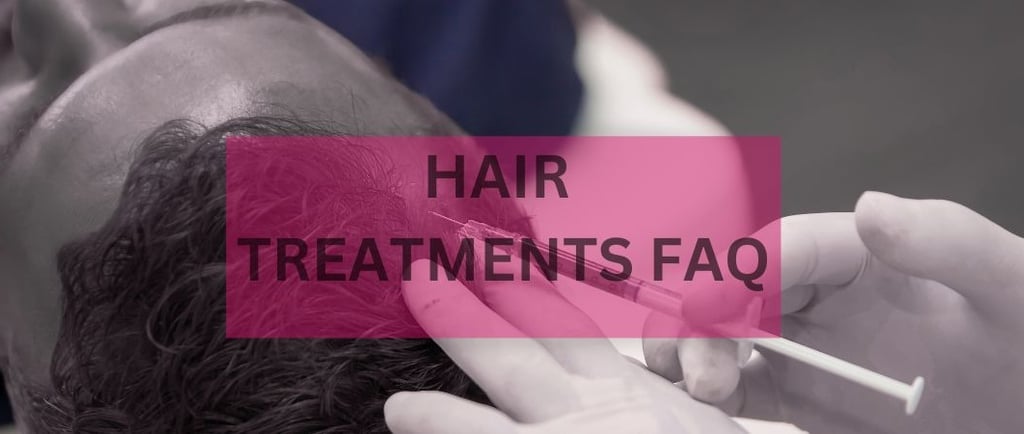
Let's Clear all your Doubts on Common Hair Treatments: PRP / GFC / Exosomes / Hair Transplant, Shall We?
Combined FAQs: PRP / GFC, Exosomes & Hair Transplant
1) What are PRP, GFC, and Exosomes—and how do they help hair?
PRP (Platelet-Rich Plasma): Your own blood is processed to concentrate growth factors that reduce shedding and thicken existing hair.
GFC (Growth Factor Concentrate): A refined process yielding higher, more consistent growth factor levels than standard PRP—often a faster early response.
Exosomes: Cell-derived vesicles rich in signaling molecules; an advanced adjunct aimed at follicle signaling, inflammation control, and repair.
All three work best where follicles are still present (thinning, not fully bald).
2) Who is the right candidate for these treatments?
PRP/GFC/Exosomes: Men & women with early–moderate thinning, postpartum or post-illness hair fall, or as support after transplant.
FUE Hair Transplant: Areas with minimal/absent follicles (receding hairline, crown gaps) and a good donor area.
We’ll assess scalp health, pattern, and any deficiencies (iron, D, B12, thyroid) before recommending a plan.
3) PRP vs GFC vs Exosomes—how do I choose?
Start with PRP when budget-friendly, proven, and suitable.
Choose GFC if you want a more concentrated growth-factor approach or had a subtle PRP response.
Consider Exosomes as an advanced add-on in select cases for signaling support.
Your dermatologist will match the option to your stage, goals, and medical profile.
4) How many sessions will I need—and how soon will I see results?
PRP/GFC/Exosomes:
Build: 4–6 sessions, 3–4 weeks apart
Maintain: Every 3–6 months
Results: Less shedding by 6–8 weeks; thicker look by 3–6 months
FUE Hair Transplant: One planned procedure; visible growth starts 3–4 months, fuller result by 9–12 months.
5) Is it painful? What about downtime?
PRP/GFC/Exosomes: Topical numbing; pinprick sensation; tenderness 12–24 hrs; routine life usually same/next day.
FUE Transplant: Local anesthesia; mild post-op soreness; back to desk work in 2–3 days; activity restrictions briefly per protocol.
6) Day-care or admission needed?
All are day-care/outpatient. You go home the same day. No general anesthesia for these protocols at our clinic (FUE under local).
7) What after-care is required?
PRP/GFC/Exosomes: No hair wash 12–24 hrs; avoid oiling, dyeing, steam/sauna, heavy workouts, and alcohol for 24–48 hrs; resume prescribed topicals as advised.
FUE: Keep grafts dry 48–72 hrs; sleep head slightly elevated; follow our gentle-wash schedule; avoid sun/helmets/heavy workouts ~10–14 days; no picking/scratching.
8) Are the results permanent? Will I still need maintenance?
Transplanted hair is generally long-lasting.
Native hair can keep thinning with time; most patients benefit from maintenance (PRP/GFC/Exosomes every 3–6 months + medical therapy when indicated) to preserve overall density.
9) Can these treatments be combined or sequenced?
Yes—often the best outcomes come from smart layering:
Calm scalp (treat dandruff/seborrhea) →
Strengthen follicles (PRP/GFC/Exosomes + medical therapy) →
Restore missing areas (FUE) →
Maintain (periodic boosters + home routine).
Combination plans are personalized to your pattern of hair loss and timeline needed to achieve results.
10) Who should avoid or delay treatment?
Active scalp infection, uncontrolled medical illness, significant platelet disorders, certain blood thinners (case-by-case), pregnancy/breastfeeding (for PRP/GFC/Exosomes), or poor donor area (for FUE).
We may request blood tests (ferritin, B12, vitamin D, thyroid) before starting to optimize results.
11) Where should I get PRP/GFC, Exosomes, or a Hair Transplant done?
Only at a board-certified dermatologist–led clinic. Check for visible doctor credentials, single-use needles/kits, documented sterilization, consent/photos, dosing protocols, and emergency readiness. Avoid salons/non-medical centers—poor asepsis can lead to infections (e.g., viral warts/HPV, bacterial), and blood-borne risks (HBV/HCV/HIV) from reused instruments.
Ray & Rio’s (Chennai) is dermatologist-supervised by Dr. Annie Flora, with strict asepsis and evidence-based treatment plans.
Contact
Block A, Plot B1, 12th Cross St, Ranga Reddy Gardens, Saraswathy Nagar North, Neelankarai, Chennai, Tamil Nadu
+91 98405 19139
We are here!!!
Neelankarai
Egmore
No. 14/31, First Street, Sait Colony, Egmore, Chennai - 600008, Tamil Nadu
© 2025 RAY & RIO SPECIALITY CLINIC